Big show this weekend: Geminid meteor shower

Donna Burton
13 December 2025, 1:40 AM
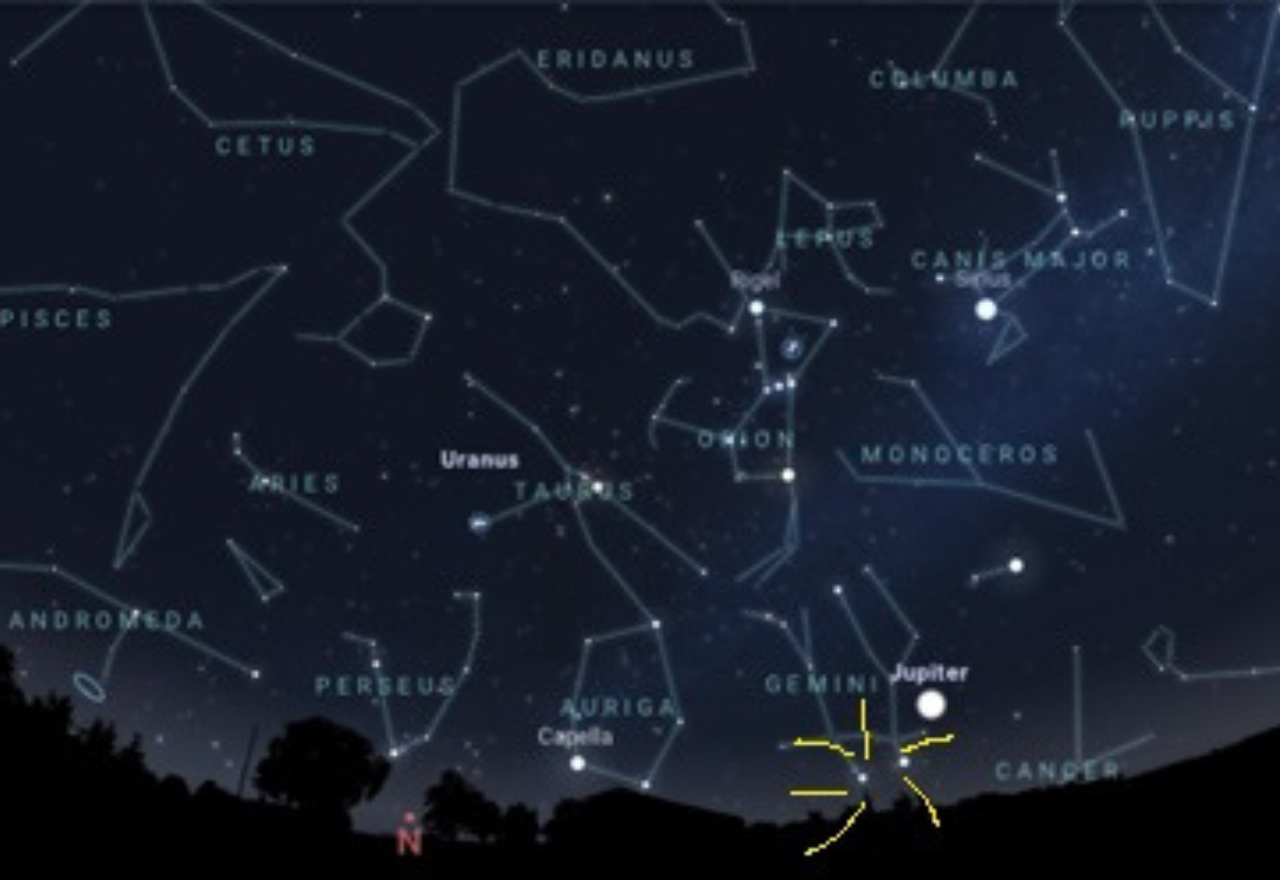 From Stellarium Online showing the radiant of the Geminids from the bright star Castor around 11pm AEDT.
The Geminid meteor shower is one of the most spectacular and reliable annual displays in the night sky, famous for producing bright fireballs that capture the imagination of stargazers.
If you're willing to be out after midnight you're in for a treat tonight (Saturday 13 December) and tomorrow night (Sunday 14 December).
Unlike most meteor showers that originate from comets, the Geminids are unusual because their parent body is an asteroid—3200 Phaethon.
This rocky asteroid leaves behind a trail of debris as it travels through space, and each December, Earth passes through this stream of fragments.
When these tiny particles enter our atmosphere, they burn up and create the brilliant streaks of light we know as meteors.
The Geminids are visible from both hemispheres, although the Northern Hemisphere enjoys higher meteor counts because the constellation Gemini climbs much higher in its night sky.
How and when
In Australia, the shower is active from about 4 to 20 December, with the peak occurring on 14 December at 3:30 am UTC.
This translates to 3:30 pm Sydney time, but there is no need to worry—the Geminids have a broad peak.
From Sydney, the radiant rises around 11 pm and reaches its highest point near 2 am, making midnight to dawn on both Saturday 13 December, and Sunday 14 December, the best windows for viewing.
To enjoy the Geminids, choose a dark location away from lights and look toward a clear patch of sky, ideally away from the Moon, which can wash out fainter meteors.
Give your eyes 15 to 20 minutes to adjust to the darkness, and lie back on a blanket or a reclining chair so you can take in as much of the sky as possible without straining your neck.
Dress warmly, bring a thermos, and allow plenty of time—meteors often appear in bursts, so patience is key.
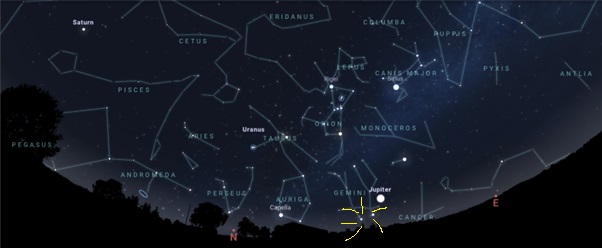
Look for Jupiter, the brightest object above the northern skyline. IMAGE: Stellarium Online
A gift from an asteroid
The Geminids are scientifically significant because they challenge traditional ideas about meteor showers.
Their origin from an asteroid rather than a comet provides valuable insight into the diversity of small bodies in the Solar System and the processes that shaped planetary formation.
Studying 3200 Phaethon and its debris helps astronomers understand how these rocky fragments interact with Earth and contribute to the dynamic nature of our skies.
How to photograph
For those keen to capture the spectacle on camera, use a tripod for stability and a wide-angle lens to cover as much of the sky as possible.
Set long exposures of 10 to 30 seconds with a high ISO, and take continuous shots to increase your chances of catching a meteor. Including a foreground element such as a tree or landscape can add interest to your images.
The Geminid meteor shower is a remarkable opportunity to experience the beauty and motion of our Solar System.
Whether you are an experienced observer or simply curious, make time to watch this celestial event—it is well worth marking on your calendar.
Fun Fact: Under ideal dark-sky conditions during the peak, you could see up to 120 meteors per hour!