Six planets in the evening sky this February

Donna Burton
14 February 2026, 7:40 AM
 Western plains spectators sitting pretty for February's planet parade.
Late February will bring a pleasant opportunity to observe several planets along the western sky after sunset.
This type of grouping is often described as a planetary alignment or planet parade, which refers to occasions when a number of planets appear close together along the ecliptic from our viewpoint on Earth.
These positions are a matter of perspective rather than physical alignment in space.
The planets remain separated by vast distances, though they appear to curve across the sky along the Sun’s path.
On 28 February, Mercury, Venus, Jupiter, Saturn, Uranus and Neptune will appear within the same broad region of sky.
This arrangement will be visible in the Southern Hemisphere too, though the arc will tilt in the opposite direction compared to the Northern Hemisphere.
Why planetary parades occur
The planets orbit the Sun in roughly the same plane, known as the ecliptic.
Because each planet travels at a different speed, their apparent positions shift gradually across the sky.
When several appear on a similar line of sight, we observe a visual alignment.
This is not a true three dimensional line of planets in space, but a projection effect.
How rare is this event?
Groupings of three to five planets are fairly common and occur every year. Larger parades, involving six or more planets, are less frequent because more precise timing is required for them to gather in the same sky sector.
A seven planet grouping occurred in February 2025, and similar large displays will occur at other points in future years.
What you can see without optical aid
From Australia, four planets may be visible to the naked eye.
Venus and Jupiter will be the brightest. Mercury will sit very low in the dusk glow and sets quickly.
Saturn may be visible but will also be low. Uranus and Neptune will not be visible without binoculars or a telescope.
Even experienced observers require optical help to detect these distant worlds.
The event spans late February into early March. Exact viewing conditions vary by location because the planets change position slightly each day.
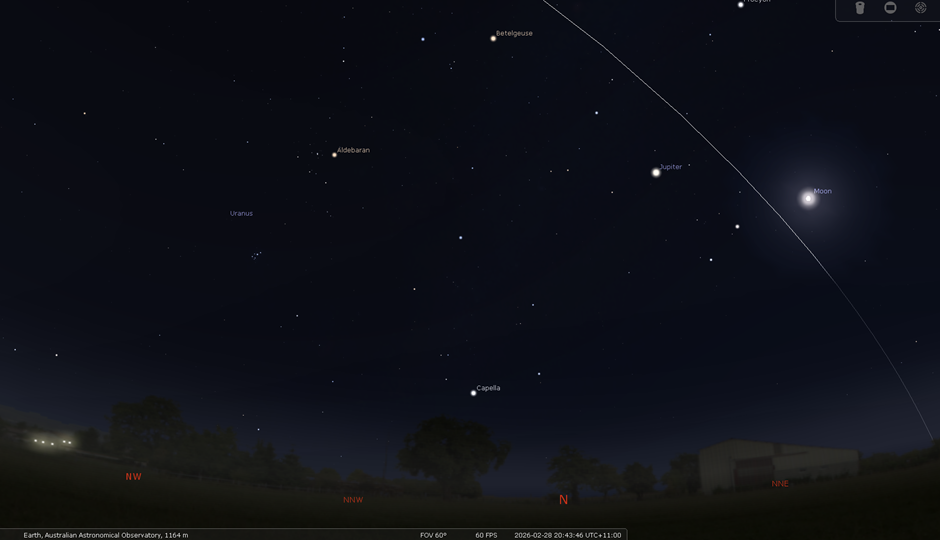
Looking East on February 28th. The white line is the International Space Station. [IMAGE: Stellarium]
Why this is not a naked eye spectacle
Many media reports describe this as a dramatic lineup of six planets. However, several factors limit what can genuinely be seen without equipment.
1. Planet brightness and distance
Uranus and Neptune are far too faint for unaided viewing in any location. They require binoculars or a telescope, as confirmed by multiple observing guides.
2. Low altitude and twilight
Venus, Mercury and Saturn will all be low in the sunset glow.
NASA notes that planets must be at least a few degrees above the horizon to be observed reliably, and ideally ten degrees or more.
Near the horizon, atmospheric scattering greatly reduces visibility. Even bright planets become difficult to identify.
3. Short viewing window
Several planets will set soon after the Sun, leaving only a short interval for observation. For the February event, sources advise that you may only have about half an hour of twilight viewing.
Due to these combined factors, the alignment is interesting but subtle, and not a row of bright points easily visible with the naked eye.
Why media overstate these events
Planetary alignments often attract significant publicity, and media coverage can amplify expectations for several reasons.
1. Appeal of rare sky events
Terms such as rare alignment or once in a lifetime easily gain attention.
Media outlets often highlight the total number of planets involved, even when only a fraction are visible without equipment.
Space.com notes that the phrase planet parade has become a common buzzword similar to terms used to describe supermoons or meteor showers.
2. Misconceptions about alignments
People often imagine the planets forming a perfect line in space.
Astronomy education sources explain that what we see from Earth is an apparent grouping, not a physical alignment. This gap between expectation and reality can lead to exaggerated reporting.
3. Historical precedent for hype
History shows that planetary alignments have long attracted dramatic predictions and public fascination.
Past events, such as those in 1962 and 2000, were accompanied by intense media interest despite no scientific basis for concern or spectacle.
4. Increased general interest in night sky events
Regular coverage of supermoons, eclipses and meteor showers encourages media focus on astronomical topics.
This can result in coverage that emphasises novelty over accuracy, especially when a high number of planets are involved.
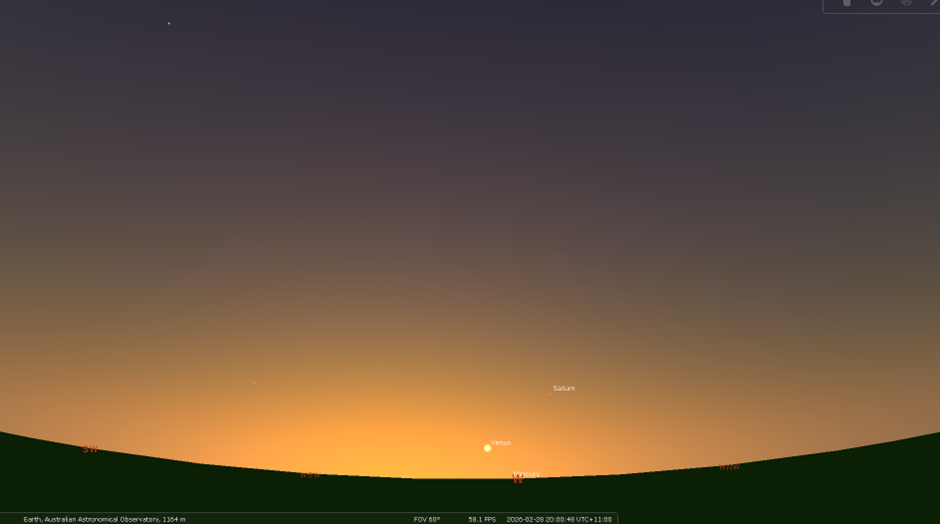
Looking West after Sunset 28th February 2026. [IMAGE: Stellarium]
When and where to look
The best opportunity for Southern Hemisphere observers is about 30 minutes after sunset, with a clear view of the western horizon.
Venus will be the brightest marker, and Mercury, if visible, will be slightly lower.
Jupiter will be higher in the east. Uranus will be high in the southern sky near the Pleiades, though will still require binoculars.
A realistic and enjoyable observation
This event offers a good chance to locate several planets in one twilight session, especially with binoculars.
With an understanding of what can and cannot be seen unaided, observers can enjoy the subtle beauty of the solar system’s layout without expecting a dramatic row of six bright points.
With thanks to Donna The Astronomer