Parental concerns over immunisation grow

Angie White
20 February 2026, 11:40 PM
The National Vaccination Insights project has found that acceptance barriers to immunisation amongst all parents surveyed have increased, a factor that may influence future vaccination levels.
While the study estimated the number of children fully vaccinated at five nationally is still measuring at 93.7% - up from 92.7% in 2024 - it revealed more parents are increasingly influenced by their own beliefs and concerns rather than any practical issue.
Study lead, Dr Jess Kaufman, Principal Research Fellow in the Vaccine Uptake Group at Murdoch Children’s Research Institute (MCRI), said the findings were proof of a shift in parental attitudes.
“Compared to last year, we’re seeing an increase in concerns about vaccine safety and a drop in trust in healthcare providers. While access issues are still relevant, reduced vaccine confidence is now a stronger influence on whether children receive their vaccinations on time.”
The top 6 barriers to childhood vaccination reported in the 2025 study by parents were:
- feeling distressed about vaccinating (32%)
- not trusting information about vaccines from doctor/nurse (8.8%)
- not being able to afford costs associated with vaccination (8.6%)
- not choosing to prioritise vaccination appointments (8.6%)
- not believing vaccines are safe (8.3%)
- finding it difficult to get an appointment (7.7%).
According to a Western area psychologist (who did not wish to be named), complacency, passivity and disempowerment, and misplaced expertise are factors that lower vaccine numbers.
“Most parents today have not seen a child, much less their child, become severely unwell or die from a preventable disease," she said.
“Add to this the mindset that parents must involve the child in decision making, also changes the narrative.
“Being a parent is tough and unpleasant decisions in a child’s best interest are hard to make, but parents need to remember that social media is not an encyclopaedia, and a chat at the local supermarket is not rigorous science."
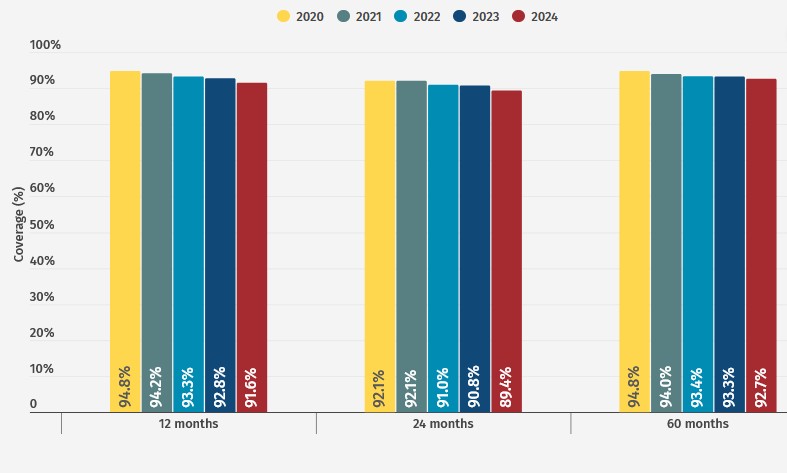
Fully vaccinated trends by age group from the National Centre for Immunisation Research and Surveillance
According to official health statistics for 2024, the fully vaccinated at 5 years rates in the Western NSW Local Health District (96.5%) and Far West NSW Local Health District (96.3%) were higher than the national average.
Nevertheless, when the Western Plains App spoke with over 20 rural parents on the subject there was a varying range of replies that reflected the survey.
These ranged from fear of side effects, parental complacency, lack of understanding of how vaccines work, parents misunderstanding the system, childhood fear of needles, social media influencers, conspiracy theorists and the current generation having not seen the horrors of preventable diseases firsthand.
While some believed vaccines were not needed, the majority said they wished to protect their children in whatever way they could.
One parent who works within the immunisation framework, but who did not wish to be named, said a lot more education needs to be provided to parents, to not only allay fears but on a practical level.
“A lot of people who are coming in from overseas are unaware of the immunisation procedures in Australia add to the decreasing numbers, along with anti-vaccers, who have filed forms with Services Australia to cease correspondence (a surge of this occurred post Covid) which means that reminders for vaccination are not sent," she said.
“Small communities out west have great community and baby nurses who are only willing to help, with information and practical advice, running regular clinics."
The study found parents of partially vaccinated children were far more likely to report negative beliefs about vaccine safety, lack of trust in vaccine information from a doctor or nurse and choosing not to prioritise vaccination over other things.
While parents of unvaccinated children stated negative beliefs about vaccine safety and belief that vaccination does not protect others.
“Parents still face practical challenges when it comes to vaccinations, such as the cost of vaccination and getting to appointments, but these issues are no longer the main drivers of missed or delayed childhood vaccinations in 2025,” Dr Kaufman said.
“The greater challenge is now building trust and ensuring supportive, empathetic conversations with healthcare providers who can respond to parents’ concerns.”