Turtles, trackers and toenails; what's going on in the Maquarie Marshes?
Kelsi Davis
17 December 2025, 6:41 AM
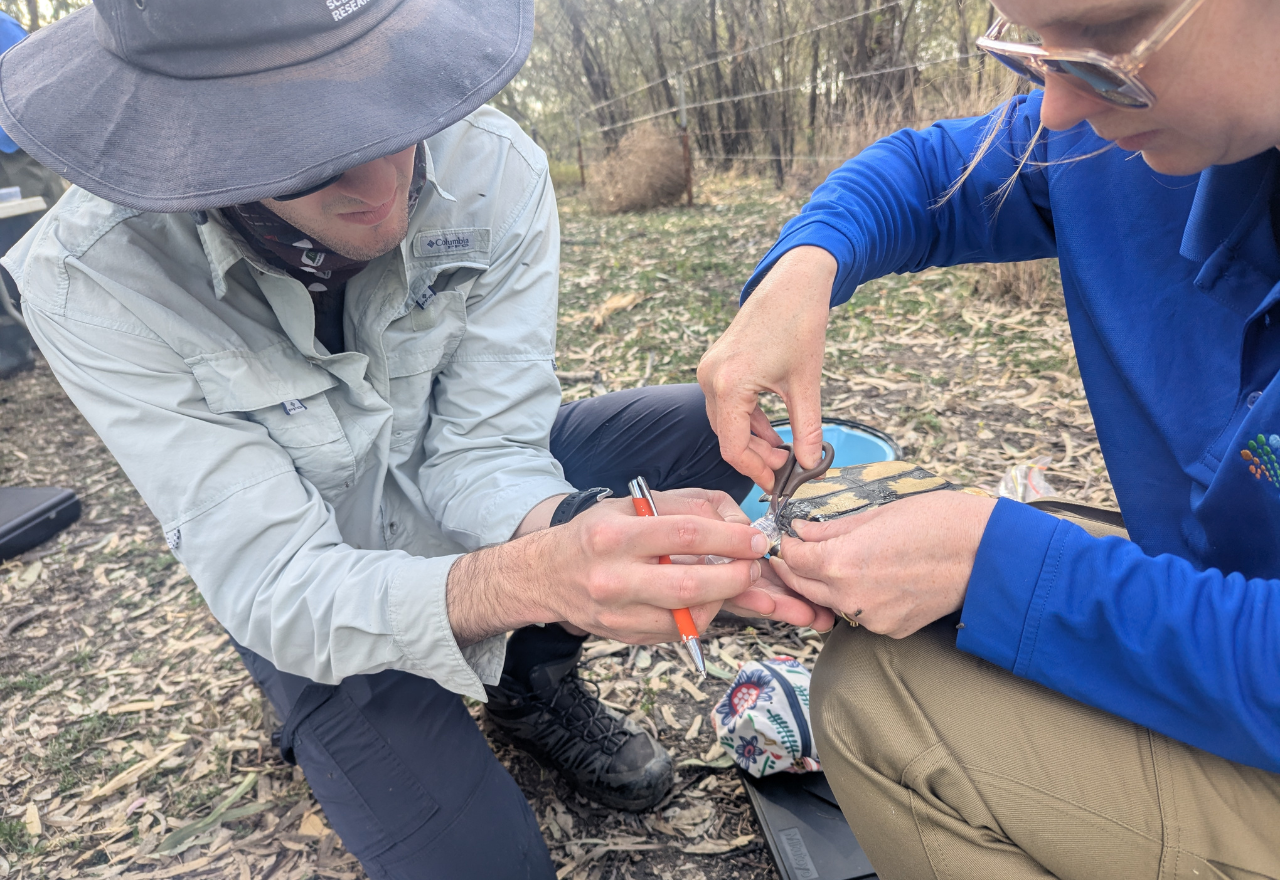 UNSW researchers Will Hall and Roxane Francis clipping turtle toenails for research [IMAGE: SUPPLIED CEWH].
A team of scientists have waded through the Macquarie Marshes to take the first steps to capture diet and movement data on native turtles.
University of New South Wales Centre for Ecosystem Science Associate Professor Kate Brandis and Environmental Honours student William Hall trudged through the swamplands to collect diet data and place trackers on 20 turtles.
Who would have thought this involves giving the reptiles a pedicure in the process?
In October the pair partnered up with Commonwealth Environmental Water Holder (CEWH) researchers to collect data and implement tracking devices on the reptiles.
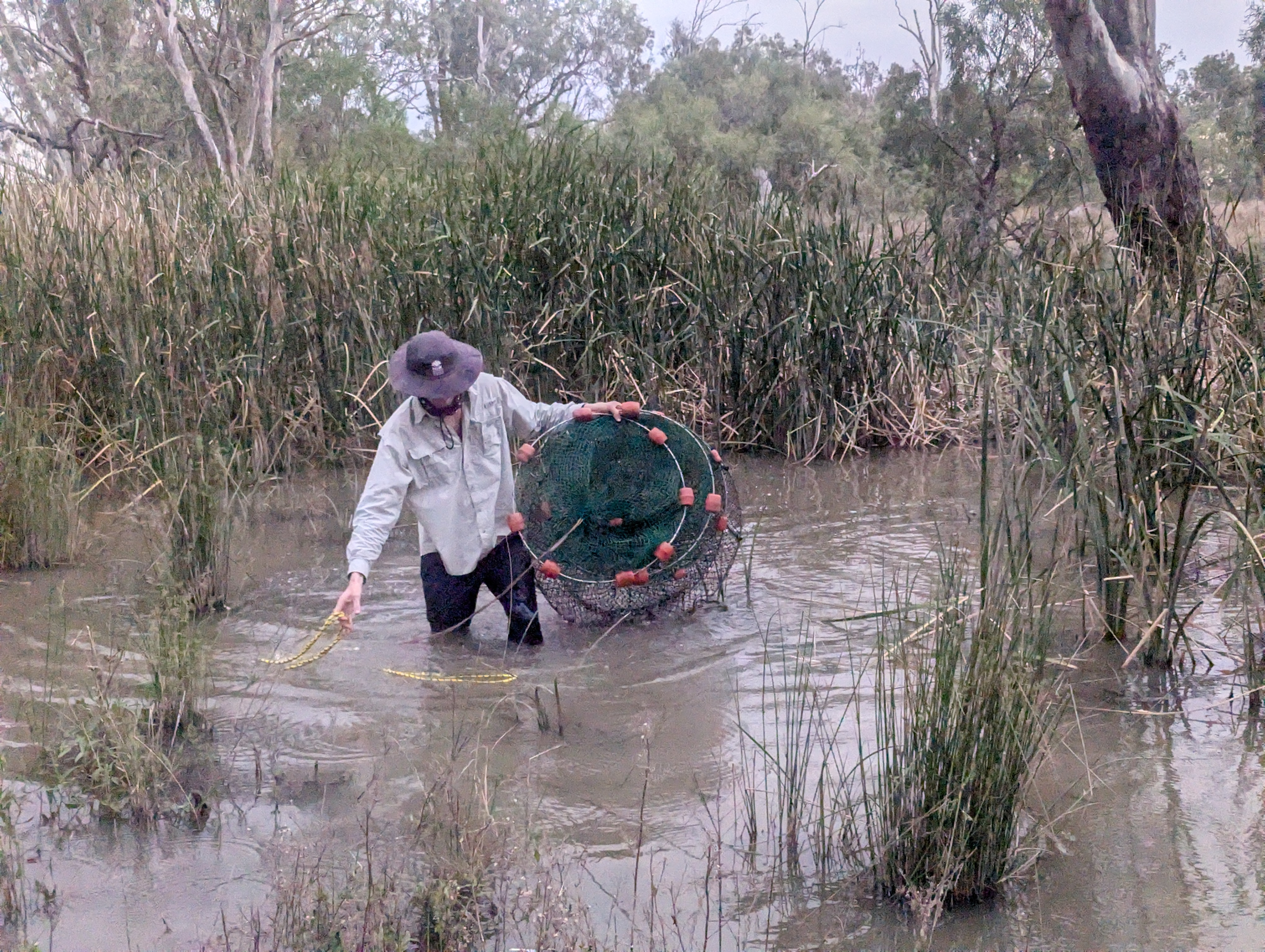
The group trudged through the wetlands in search of at least 20 broad-shelled and eastern long-necked turtles.
This was easier said than done.
“There was a lot of time and effort put into catching the turtles, it took two weeks to capture the 20 turtles we needed for the study,” Professor Brandis says.
Mr Hall said the turtles needed to be a certain size and weight for surveying, and the muddy waters and almost 40 degree heat did not help the scientists' hit their target number.
"Some days I caught no turtles, other days I caught some that weren't big enough.
"I tried a few different sites in the Northern and Southern Marsh, but only caught turtles at three sites on the Macquarie River in the Northern Marsh."
Mr Hall said they attached a tracker to ten of each of the turtle species caught.
The University of New South Wales Environmental Biology Honours student said the process was painless for the reptiles.
"It's not too much weight and it doesn't affect their movement," he said.
The turtle's movement through the Marshes is now being recorded.
The scientists placed receivers throughout the wetland, and as the turtles pass a receiver the data will be recorded electronically.
Professor Brandis said the results were downloaded a few weeks after the trackers were implemented, however the period was too short to show significant data.
She says the data will be downloaded roughly every six months to illustrate better travel results across the Marshes.
The two week span did show some speedy reptiles, that would make anyone question the turtle and hare fable.
Mr Hall said one of the broad-shelled turtles travelled roughly seven kilometeres downstream through the Marshes in just two days and an eastern long-necked turtle travelled a similar distance upstream in eleven days.
"It's impressive because in one study in southern NSW they found another species that moved 20 kilometres in a whole season.
"So seven kilometres is pretty good."
A broad shell turtle is released back into the Marshes with a tracker [VIDEO: SUPPLIED CEWH]
The scientists were not only placing tackers on the turtles when they were caught, but also collected two toenail clipping samples from each of the reptiles.
Professor Brandis said the scientists could identify the diet of the turtles but putting the toenail samples through a stable-isotope process.
"You put the sample into a machine called a mass spectrometer and it analyses the amount of carbon 13 and nitrogen 14 in the sample," she says.
"From that we can get an indicator of what sorts of things they've been eating."
She says she expects this process to be completed before June, 2026.
This is the first exclusive study on turtle movement in the Macquarie Marshes, and Mr Hall intends to use the data for his honorary thesis.
Professor Brandis says through the CEWH science program, Flow-Monitoring, Evaluation and Research (MER) program the data collected will be used to inform decision making for the delivery of environmental flows.
During October and November, around 100 gigalitres of water was delivered to the Marshes to support the wetland ecosystem.
The water release was delivered by the CEWH and the New South Wales Department of Climate Change, Energy, the Environment and Water.
Although turtle research across the state is not unusual, the Flow-MER, DCCEEW and University of NSW Funded research is the first localised Macquarie Marshes turtle movement and diet study.
In 2014 Dr Roxane Francis conducted a study on diet and habitat of broad-shelled turtles, eastern long-necked turtle, and the Macquarie turtle across the Murray-Darling Basin.
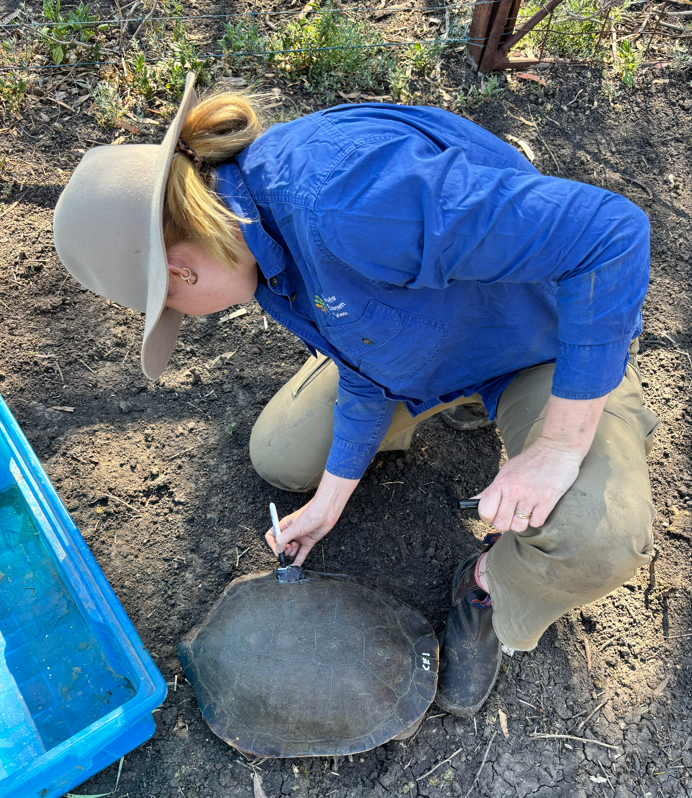
Dr Francis joined the project in October [IMAGE: SUPPLIED CEWH].
"10 years ago when the samples were done was during a very dry period," she says.
"We might see some differences in overall health and what they've been eating.
"What would be even better is if we saw no difference so that it showed that they were actually probably still healthy even during a dry period."
Mr Hall said there have been a few turtle tracking studies in the Murray River and Gwydir
"Two or so studies have tracked turtles in the Gwydir and into reaches of the Barwon-Darling.
"One study near Armidale looked at how eastern long-necked turtles are affected by fences on agricultural landscapes."